Why Your Lower Back Hurts During Pilates (& Movements That Can Help)
Pilates is known for strengthening your core, improving posture, and helping your body move more efficiently. So why do so many people experience lower back discomfort during class?
If you’ve ever been in the middle of a Pilates exercise and thought, “Why am I feeling this in my back instead of my abs?” — you are not alone.
Lower back discomfort during Pilates is often a sign that your body is compensating. It doesn’t necessarily mean you are “doing Pilates wrong.” More often, it means your body needs a little more awareness, mobility, or support in certain areas.
Why Does My Lower Back Hurt During Pilates?
1. Your Deep Core Muscles Aren’t Fully Engaging
One of the biggest goals of Pilates is learning how to properly recruit your deep core muscles — including the transverse abdominis, pelvic floor, and muscles that stabilize your spine.
When these muscles are not activating efficiently, your lower back muscles may step in to create stability. Instead of your core supporting the movement, your back ends up doing extra work.
You may notice this during exercises like:
Table top
Leg lowers
Teaser variations
Planks
2. Your Pelvis May Not Be Finding a Neutral Position
Many people spend their days sitting, driving, working at a desk, or looking down at a phone. Over time, your pelvis may develop movement patterns that affect how your spine feels.
If your pelvis constantly tips forward (anterior tilt), your lower back may become more compressed and tight.
If your pelvis tucks excessively under (posterior tilt), you may lose the natural curves of your spine and create tension elsewhere.
Learning how to move your pelvis intentionally is an important part of building a healthier relationship with your spine.
3. Your Spine Needs More Mobility
Your spine is designed to move in many directions — flexion, extension, rotation, and lateral flexion (side bending).
When certain areas of your spine become stiff, your body often finds movement elsewhere. This can create extra stress in your lower back.
Three Pilates Movements to Help Support Your Lower Back
1. Pelvic Rocking
This exercise teaches you how to move between an arched position (anterior tilt) and a rounded position (posterior tilt), allowing you to understand where neutral alignment feels.
How to do it:
Lie on your back with your knees bent and feet planted on the floor.
Allow your spine to relax naturally.
Slowly tilt your pelvis forward to gently arch your lower back away from the floor.
Then gently tuck your pelvis, allowing your lower back to soften toward the mat.
Move slowly between these two positions, focusing on control.
Why it helps:
Pelvic rocking improves awareness of your spinal position and helps your core muscles learn how to stabilize your pelvis without gripping through your lower back.
2. Seated Mermaid
Many people with lower back discomfort also have tight hips and limited side-body mobility. Mermaid encourages length through the spine while improving lateral flexion and rotation.
How to do it:
Sit with one leg folded in front and one leg folded behind you (or modify your seated position if needed).
Sit tall through your spine before moving.
Reach one arm overhead and side bend toward the opposite side.
Focus on creating length rather than collapsing into the stretch.
Return to center with control and repeat on the other side.
Why it helps:
This movement creates mobility through the spine and opens areas that often become restricted from daily posture habits.
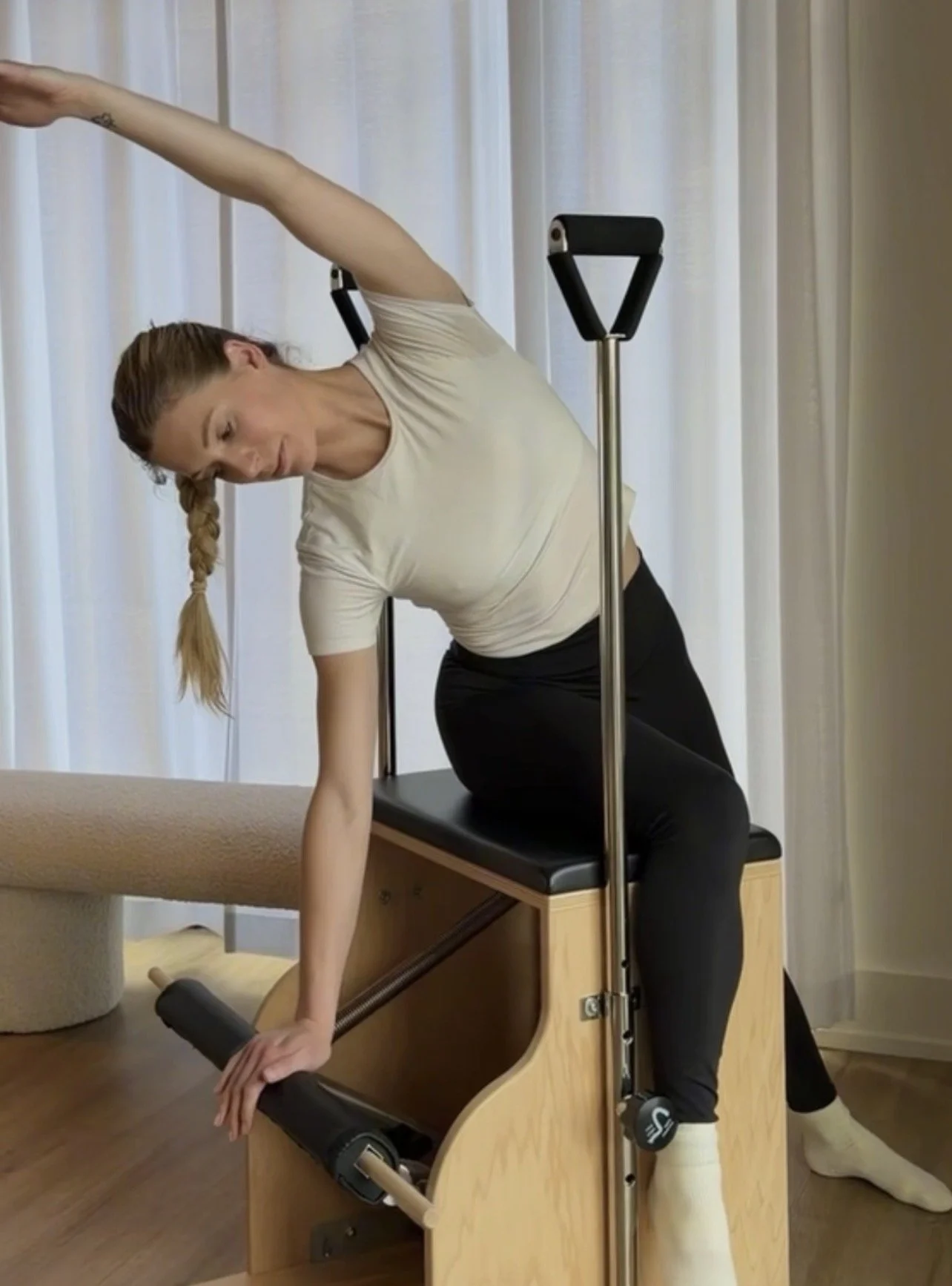
Mermaid on the Pilates chair
3. Saw
Rotation is an important movement pattern that many people lose in everyday life. The Saw encourages your spine to move while your core supports the motion.
How to do it:
Sit tall with your legs extended slightly wider than hip distance apart.
Reach your arms out to the sides.
Inhale as you rotate your torso.
Exhale as you reach your opposite hand toward your pinky toe.
Return to center and repeat on the other side.
Why it helps:
The Saw teaches your body how to rotate from the spine while maintaining abdominal support and length.
Still Feeling It In Your Low Back? Book a Private Session at Pilates House Lemont.
If your lower back is consistently taking over, it may be time to slow down and focus on:
Your breathing pattern
Your pelvic position
Your core connection
Your spinal mobility
Your exercise modifications
Small adjustments can create a completely different experience in your body.
If you’re experiencing lower back discomfort during class and want to work 1:1 with an instructor, click here to request a private Pilates session.